
Following up a child's absence: what the EYFS requires
The EYFS requires every registered provider in England to follow up absences in a timely manner. When a child is absent without notice, or for a prolonged period, you must try to reach the parents and then the alternative emergency contacts, and any concern must go to local children’s social care and/or a police welfare check. You also need a written attendance policy, shared with parents, that sets out how they should report absence and what you will do if they don’t.
The rules arrived in September 2025 and are unchanged in the framework that has applied since 1 September 2026. The framework sets the duty. It does not set the times. That part is yours to decide, and this guide gives you a starting point.
What does the EYFS actually say about absence?
The wording is almost identical in both frameworks: paragraphs 3.11 and 3.12 of the group and school-based framework, and 3.12 and 3.13 of the childminder framework. In plain terms, you must:
- Follow up absences in a timely manner. Every absence, not only worrying ones.
- Try to contact parents and then emergency contacts when a child is absent without notification or for a prolonged period.
- Look at patterns and trends, and the child’s personal circumstances, when deciding whether an absence counts as prolonged. That decision is your professional judgement.
- Consider vulnerability: the child’s, the parent’s, and their home life.
- Refer concerns to local children’s social care and/or request a police welfare check.
- Have an attendance policy you share with parents. It must cover how parents report absence and what you will do when a child is absent without notice or for a long time. The framework’s examples are following your safeguarding procedures, following up with parents, and calling emergency contacts when parents cannot be reached.
Separately, the records section (3.99 for group settings, 3.98 for childminders) says you should, where possible, hold more than two emergency contact numbers for each child.
Why the rule exists
The DfE’s consultation response puts it plainly: repeated or long absence from an early years setting can be a warning sign, and there have been cases where serious harm might have been prevented if an absence had been reported. Schools already had this duty. The change brought nurseries and childminders into line, for children who are too young to tell anyone what is happening at home.
Most absences are coughs, holidays and grandparents. The procedure exists for the small number that are not, and it only works if you run it for every child, every time. Staff who call only the families they are worried about will eventually miss the one they weren’t worried about.
Who should make the call?
Decide this in advance and write it down, because at 9:45 on a busy Monday nobody will volunteer.
- First call: whoever takes the register, or the room leader. They know the child and can hear whether something sounds wrong.
- Emergency contacts: the room leader or manager. It is a more delicate call, and it needs someone who can judge what to say.
- Escalation to children’s social care or the police: your designated safeguarding lead (DSL), or their deputy. Name both, so the step never waits for one person’s day off.
For a childminder, all three are you. Write down who covers when you are unwell, and make sure parents know that person’s number.
A timed escalation ladder you can adapt
The times below are a template, not a legal requirement. The EYFS only says “timely”. Set times that fit your opening hours and your families, put them in your attendance policy, and tell parents at settling-in so the first call never comes as a surprise.
| Step | When (adjust to suit) | Who | What |
|---|---|---|---|
| 1. Register check | Within 30 minutes of the child’s usual arrival time | Room staff | Check messages, the diary and any known appointments. If there is no explanation, move to step 2. |
| 2. Call the parents | By 10:00 for a morning session | Room leader | Call each parent with contact details. Leave a voicemail and send a text. Note the time of every attempt. |
| 3. Call emergency contacts | By 11:00 if no parent has replied | Manager | Work through the contacts in order. Ask only whether they know where the child is. Do not share concerns. |
| 4. DSL review | By 12:00 if still no contact | DSL | Look at the child’s history, known vulnerabilities and any open concerns. Decide whether to wait, keep trying, or escalate now. |
| 5. Escalate | Same day, as soon as the DSL decides | DSL | Contact local children’s social care (use your local reporting procedure) and/or request a police welfare check. If a child may be in immediate danger, call 999. |
| 6. Close the loop | When contact is made | Room leader | Record the reason given and the expected return date. Mention it gently at pick-up or drop-off. |
Two judgement calls sit on top of the ladder:
- Skip steps for a child you already worry about. If there is an open safeguarding concern, a child protection plan, or a recent disclosure, the DSL should look at the absence at step 1, not step 4.
- Short sessions need shorter gaps. For an afternoon-only child, run the same steps in hours rather than across the day.
When does absence become a pattern?
The framework asks you to consider patterns and trends, so someone has to actually look. A weekly review by the manager or DSL takes ten minutes. Things worth noticing:
- the same day of the week missed repeatedly, such as every Monday
- absences that follow a bruise, a disclosure or a difficult conversation at pick-up
- a run of short notice calls from someone other than the usual parent
- a child whose attendance drops sharply after a change at home, such as a new partner, a move or a new baby
- vague reasons that shift from call to call
A pattern is not proof of anything. It is a reason for the key person to have a warm conversation, and for the DSL to decide whether it belongs on the child’s safeguarding record.
What to write in your attendance policy
Keep it short enough that parents will read it. It should cover:
- How and by when parents should tell you about an absence (a phone number and a cut-off time).
- That you will call if you have not heard by that time, and why: it is a safeguarding duty, not a telling-off.
- That you will call emergency contacts if you cannot reach them.
- That you may follow your safeguarding procedures, which can include contacting children’s social care or the police, if you cannot make contact or are worried.
- How you treat longer absences and holidays, and what you ask parents to tell you in advance.
- A request to keep emergency contacts up to date, with a reminder at least once a year.
What to record
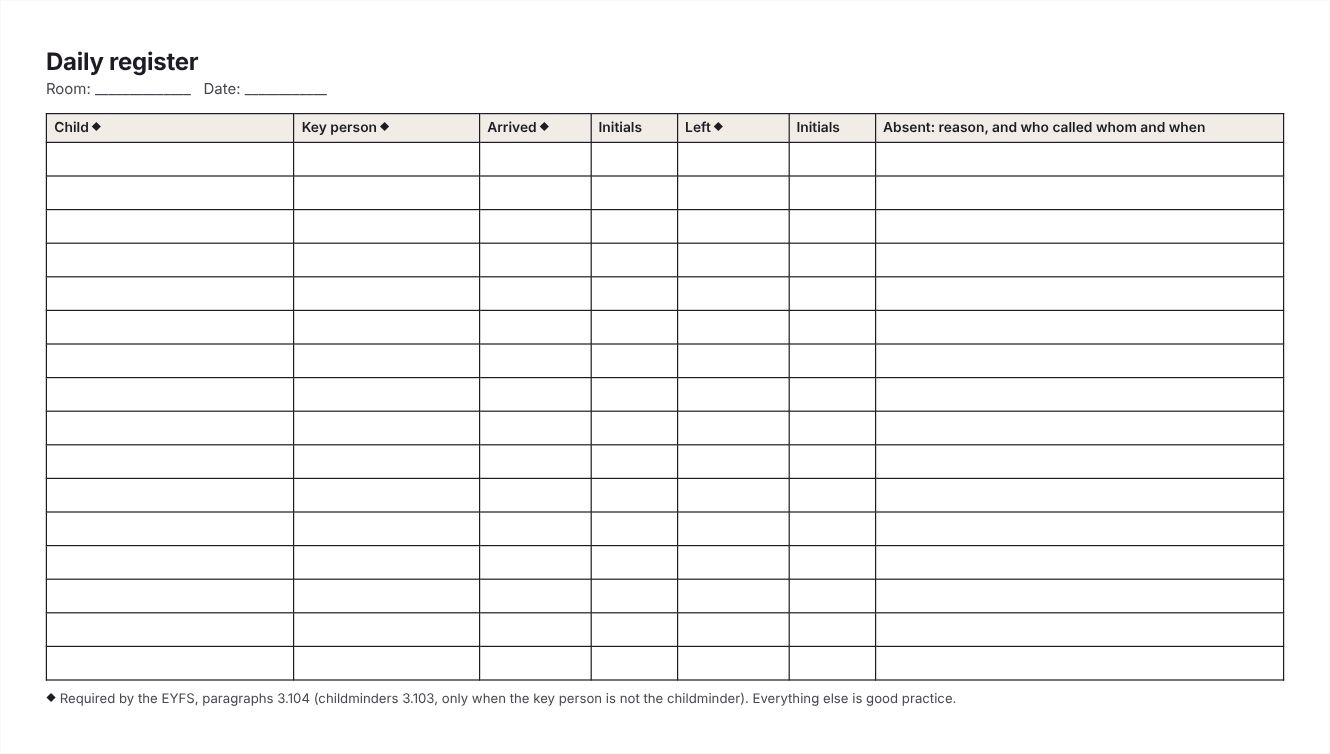
Record every step of every follow-up, including the ones that end in “grandma had him, sorry”. A clear record is what shows an inspector the procedure is real, and it is what lets you spot a pattern later. For each absence note:
- the date and the time you noticed
- each contact attempt: who, how, what time, and the result
- the reason given and who gave it
- the expected return date
- any escalation, the DSL’s decision and the reasons for it
Keep the record with the child’s attendance record, and move anything that becomes a concern into your safeguarding records, which should be held securely and seen only by those who need them.
Keeping emergency contacts useful
Emergency contacts go stale quietly. People change numbers, split up, move away. A few habits help:
- Ask for contacts at registration and again every September.
- Ask each family for more than two, and record a reason when a family genuinely can’t give that many.
- Check each new number works the first time it is added.
- Make sure contacts know they are listed. A grandparent who has never heard of the nursery is less useful than one expecting your call.
If a family cannot give you more than one or two contacts, that is worth knowing in itself. It may be the family who most needs a nursery that notices when a child doesn’t arrive.
Questions we get asked
Does the EYFS say how quickly we must call when a child does not arrive?
No. It says absences must be followed up in a timely manner and leaves the timing to you. Set your own times in your attendance policy, and make them early enough that a call happens the same morning.
How many emergency contacts do we need for each child?
The framework says settings should, where possible, hold more than two emergency contact numbers for each child. It is a 'should', so you can depart from it with a good reason, for example a family newly arrived in the country with no one else to name. Record the reason.
What counts as a prolonged absence?
The EYFS does not define it. You decide, using professional judgement about the child's patterns, vulnerability and home life. A week off for a known holiday is not the same as three unexplained days for a child already on your radar.
Can we ask the police to check on a family?
Yes. The framework says concerns must be referred to local children's social care and/or a police welfare check requested. If you believe a child is in immediate danger, call 999.
Does this apply in Scotland, Wales or Northern Ireland?
No. This guide covers the EYFS, which applies in England only. The other nations have their own standards.
Sources
- Early years foundation stage statutory framework for group and school-based providers, from 1 September 2026 (DfE)
- Early years foundation stage statutory framework for childminders, from 1 September 2026 (DfE)
- Early years foundation stage (EYFS) statutory framework: publication page and change history (DfE)
- Early years foundation stage safeguarding reforms: government consultation response, October 2024 (DfE)
This guide is for early years settings in England and reflects the sources above as of 24 September 2026. It is practical guidance, not legal advice: where it and the statutory framework differ, the framework wins. Spotted something out of date? Tell us at hello@coatpeg.co.uk.