
Accident and incident records in nursery: who to tell, and by when
Every accident, injury and piece of first aid given to a child must be written down, and the parent must be told the same day or as soon as reasonably practicable. If the accident is serious, you must also notify Ofsted (or your childminder agency) within 14 days at the latest, and tell your local child protection agencies. RIDDOR, the HSE reporting scheme, covers far fewer children’s injuries than most people assume.
This guide covers settings in England. The rules come from paragraphs 3.78–3.79 of the EYFS framework for group and school-based providers and 3.77–3.78 of the childminder framework, both effective from 1 September 2026. The wording is the same in both, and unchanged from the 2025 version apart from paragraph numbers.
What does the EYFS require for accident records?
Four things, for every child, every time:
- A first aid box with items suitable for children, accessible at all times.
- A written record of the accident or injury and of any first aid treatment.
- Telling the parent or carer about the accident or injury and any first aid, on the same day or as soon as reasonably practicable.
- Notifying Ofsted and child protection agencies when it is serious (see below).
The record exists so that a parent who finds a bruise at bath time already knows how it got there.
You also need a paediatric first aider on the premises whenever children are present, and on every outing (paragraph 3.37 for group settings, 3.42 for childminders).
What goes in a good accident record?
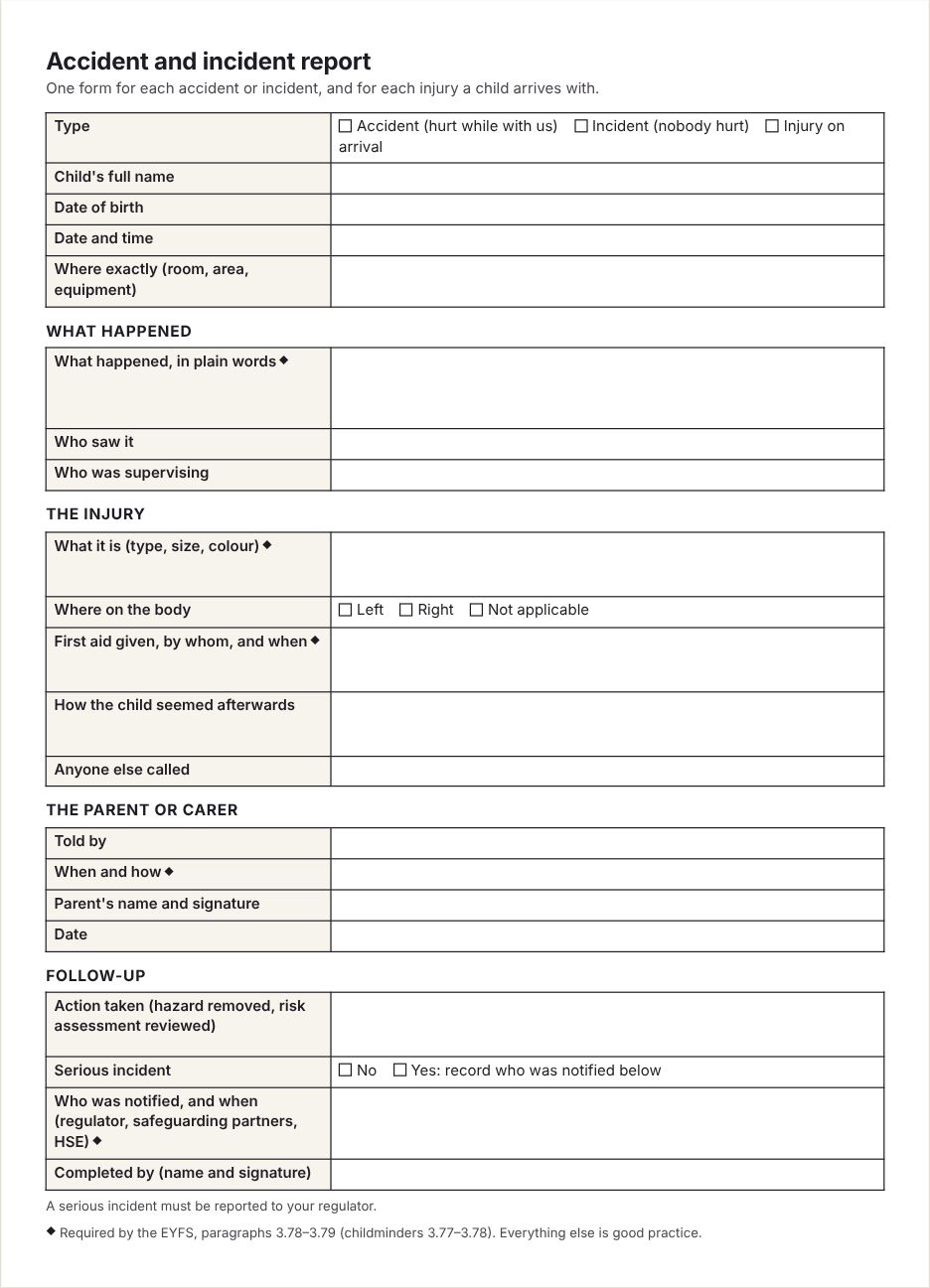
The EYFS does not prescribe a form. This field list is what makes a record useful when someone reads it months later, including a parent, an inspector or a solicitor.
| Field | Why it matters |
|---|---|
| Child’s full name and date of birth | Unambiguous identification |
| Date and time of the accident | Patterns by time of day show up later |
| Exact location (room, area, piece of equipment) | Lets you find the hazard, not just the incident |
| What happened, in plain factual words | What was seen, not what was assumed |
| Who saw it, and who was supervising | Supports your supervision account |
| The injury: type, body part, left or right, size | “Bump to head” is not enough; “2cm red mark above left eyebrow” is |
| First aid given, by whom, and when | Required by the EYFS |
| How the child seemed afterwards | Especially for head injuries |
| Whether anyone else was called (999, 111, parent to collect) | Evidence of escalation |
| When and how the parent was told, and by whom | Proves you met the same-day duty |
| Parent’s acknowledgement (signature or confirmation) | Good practice, not a statutory requirement |
| Follow-up action (hazard removed, risk assessment reviewed) | Shows you learned from it |
| Whether Ofsted, child protection agencies or HSE were notified, with dates | One place to check nothing was missed |
Write it up before the end of the session while memories are fresh. If a colleague saw it and you did not, they write it.
Existing injuries: recording what came in the door
The EYFS does not name an “existing injury” form, but recording injuries a child arrives with is standard safeguarding practice, and it protects staff too. When a parent mentions or you notice a mark at drop-off, record what you see, what the parent says happened, the time, and who spoke to them. Do not examine a child beyond what you can see in normal care.
If the explanation does not fit the injury, or injuries keep appearing, that is a safeguarding matter, not an accident record. Follow your safeguarding procedure and speak to your designated safeguarding lead the same day.
When do you have to tell Ofsted about an accident?
A registered provider must notify Ofsted, or the childminder agency they are registered with, of any serious accident, illness or injury to a child in their care, or the death of a child, and of the action taken. The deadline is as soon as reasonably practicable and in any event within 14 days. Failing to do so without reasonable excuse is an offence. Food poisoning affecting two or more children must be notified on the same terms.
Ofsted’s guidance lists what it counts as serious:
- anything needing resuscitation
- admission to hospital for more than 24 hours
- a broken bone or fracture
- dislocation of a major joint, such as shoulder, knee, hip or elbow
- any loss of consciousness
- severe breathing difficulty, including asphyxia
- anything leading to hypothermia or heat-induced illness
- loss of sight (temporary or permanent), a penetrating eye injury, or a chemical or hot metal burn to the eye
- injury or medical treatment from a substance inhaled, swallowed or absorbed through the skin, or from an electric shock
Minor injuries do not need reporting: sprains, strains, bruising, cuts, grazes, minor burns and scalds, insect bites without an allergic reaction, dislocated fingers or toes, and wound infections. The exception is a minor injury that needs hospital treatment for more than 24 hours.
Fourteen days is the outer limit, not the target. Report through Ofsted’s online form; you will need your reference number.
Ofsted also wants to hear about the death of, or a serious accident or injury to, anyone else on the premises, such as a member of staff, unless you only look after children from birth to five.
Schools that run early years provision under an exemption from registration are not “registered providers”, so the Ofsted notification duty is worded for registered settings. The child protection duty below applies to all providers.
Who else do you have to tell?
Both frameworks also require you to notify local child protection agencies of any serious accident or injury to, or the death of, a child in your care, and to act on their advice. The framework gives no separate deadline, so treat it as promptly as the Ofsted notification. Your local authority’s early years or safeguarding team can tell you which contact they expect; find out now, not on the day.
When does RIDDOR apply to a nursery?
RIDDOR is the law on reporting workplace incidents to the enforcing authority. HSE’s schools guidance, which also covers nursery provision, is clear that most incidents to children are not reportable.
For children (and visiting parents), an incident is reportable only if both of these are true:
- It arose out of or in connection with a work activity. That means it was caused by the condition of the premises or equipment, how equipment was used, or inadequate supervision or organisation. A child tripping over their own feet is not; a child falling because a gate latch was broken is.
- The child died, or was taken directly from the scene to hospital for treatment. A trip to A&E later that evening by the parent does not count. Examinations and tests are not treatment, and going as a precaution with no apparent injury is not reportable.
A child taken to hospital because of a medical condition, such as an asthma attack or a seizure, is not reportable because it did not come from the work activity.
For staff, the test is wider. Report deaths and specified injuries (for example most fractures other than fingers, thumbs and toes, or loss of consciousness from a head injury) without delay, and injuries that keep someone off normal work for more than seven days (not counting the day of the accident) within 15 days. Injuries causing more than three days’ absence must be recorded but not reported. A back injury from lifting a child that keeps a practitioner off for two weeks is a typical nursery example.
Deaths, specified injuries and non-worker hospital cases must be reported without delay and received within 10 days. Report online on HSE’s site. HSE’s guidance notes that for privately run nurseries the enforcing authority is the local authority rather than HSE.
Childminders: HSE’s guidance is written for employers and people in control of work premises. If you are unsure whether you are the responsible person in your own home, ask HSE rather than guessing.
Who do I tell, by when? A decision table
| What happened | Parent | Ofsted or CMA | Child protection agency | HSE (RIDDOR) |
|---|---|---|---|---|
| Minor accident, first aid given | Same day or as soon as reasonably practicable | No | No | No |
| Head bump, no loss of consciousness | Same day; tell them what to watch for | No | No | No |
| Any loss of consciousness | Immediately | Yes, within 14 days | Yes, promptly | Only if caused by premises, equipment or supervision and the child went straight to hospital for treatment |
| Broken bone | Immediately | Yes, within 14 days | Yes, promptly | As above |
| Child taken by ambulance from the setting after a fall from faulty equipment | Immediately | Yes, within 14 days | Yes, promptly | Yes, without delay, received within 10 days |
| Food poisoning affecting two or more children | Same day | Yes, within 14 days | Only if it is a serious illness | Not under the test for children |
| Staff member off work more than seven days after an accident at work | n/a | Not if you only care for children aged 0–5 (see below) | No | Yes, within 15 days |
| Death of a child | Immediately | Yes, as soon as possible | Yes, immediately | Yes if it arose from a work activity |
Telling parents well
Tell them in person at collection where you can, with the written record in hand, before they see the injury themselves. Say what happened, what you did, and what to look out for tonight. If the injury is more than minor, phone before collection.
Keep the acknowledgement with the record. In Coat Peg, parents are sent each report as soon as it is filed and confirm in the app that they have read it, and the nursery can see who has read it and when, without chasing signatures at the door. The notification does not replace telling them in person.
What makes accident records useful, not just compliant
Review them monthly. Look for the same corner, the same time of day, the same piece of equipment, the same child. A cluster of accidents at 11:45 in the toddler room says more about lunchtime staffing than any single form.
Questions we get asked
Do parents have to sign the accident form?
The EYFS requires you to inform parents, not to collect a signature. A signature or a written acknowledgement is good practice because it proves the parent was told, which matters if the injury is questioned later.
Do I need to tell Ofsted about a bumped head?
Not usually. Ofsted treats cuts, grazes, bruising and similar as minor. You must tell Ofsted if there is any loss of consciousness, or if a minor injury needs hospital treatment lasting more than 24 hours.
A child went to A&E as a precaution but nothing was found. Is that RIDDOR?
No. HSE's schools guidance says there is no need to report people taken to hospital purely as a precaution when no injury is apparent, and examinations and diagnostic tests do not count as treatment.
How long should we keep accident records?
The EYFS says records about individual children must be kept for a reasonable period after they leave, and leaves the period to you. Decide it, write it in your policy, and apply it consistently. Any record you make under RIDDOR must be kept for at least three years.
Does this apply in Scotland or Wales?
The EYFS and Ofsted notification rules apply in England only. RIDDOR applies across Great Britain, but settings in Scotland and Wales answer to their own regulators for everything else.
Sources
- Early years foundation stage statutory framework for group and school-based providers, effective 1 September 2026 (DfE)
- Early years foundation stage statutory framework for childminders, effective 1 September 2026 (DfE)
- Report a serious childcare incident (Ofsted)
- Childcare: reporting children's accidents and injuries (Ofsted)
- Incident reporting in schools (accidents, diseases and dangerous occurrences), EDIS1 (HSE)
- When do I need to report an incident? RIDDOR (HSE)
This guide is for early years settings in England and reflects the sources above as of 25 September 2026. It is practical guidance, not legal advice: where it and the statutory framework differ, the framework wins. Spotted something out of date? Tell us at hello@coatpeg.co.uk.