
Nursery parent communication: what to share, when and how
The EYFS asks you to keep a regular two-way flow of information with parents, to tell them the same day about accidents, first aid, medicines and physical intervention, and to keep them up to date with their child’s progress. It does not ask for a running commentary. Communication that lasts is one short daily summary, a proper conversation at pick-up, a termly look at learning, and hard conversations held in person, through channels the setting controls rather than staff’s own phones.
This guide covers England. Scotland, Wales and Northern Ireland have their own frameworks.
What does the EYFS actually require you to share with parents?
Less than most settings think, and more specific. Paragraph numbers below are from the group and school-based framework effective 1 September 2026, with the childminder framework in brackets.
- A regular two-way flow of information with parents, and with any other setting the child attends (3.95; childminders 3.94). If a parent asks, their comments should go into the child’s records.
- Same-day notice of any accident or injury and any first aid given (3.78; 3.77), any medicine given (3.62; 3.61), and any physical intervention (3.76; 3.75). The wording is the same day, or as soon as reasonably practicable.
- Progress. Practitioners should keep parents up to date with their child’s progress (2.3), must discuss any worry about a prime area with the parents (1.13; 1.7), and must give a short written summary at the progress check between two and three.
- Standing information: how you deliver the EYFS, daily routines, food, SEND support, policies, how staffing is organised, the child’s key person, and an emergency number (3.100; 3.99).
What is not on the list matters too. The framework says there is no requirement to keep written records of ongoing assessment (2.5), and Ofsted’s inspection information states it does not require photographic evidence of children’s learning. The volume of posts many settings produce is a choice, not a rule.
Why WhatsApp groups cause problems
A room WhatsApp group feels quick and friendly. It tends to go wrong in three ways.
Data protection. The ICO’s guidance on subject access says it is not usually appropriate for staff to hold information about people on personal devices, including private messaging apps, and that information held there for the organisation may fall within a subject access request. A group chat also shows parents’ details to one another, and one photo sent to the wrong group is a breach involving a child.
Safeguarding. Government online safety guidance for early years practitioners tells staff not to give parents their personal contact details and to keep professional contact to a work email, phone number or setting-approved platform. Your safeguarding policy must already say how mobile phones and cameras are used in the setting (3.6; 3.7). A staff member’s personal WhatsApp sits awkwardly with both.
Out-of-hours pressure. A group chat has no closing time. A question at 9pm gets a reply at 9.05pm because someone felt they had to, and now every parent expects it. Ofsted’s toolkit asks whether leaders keep workload manageable and avoid unnecessary burdens. An always-on chat is an unnecessary burden.
Is more communication always better?
No. Notification overload is real, and it works against you. Twelve pings a day from the same app teach a parent to mute it, and then the one message that matters, a temperature at 2pm, is missed. The fix is fewer, better messages, and a clear line between what can wait until the end of the day and what needs a phone call now.
This is the thinking behind Coat Peg’s design: families get one notification at the end of the day rather than one per post. The exceptions are the two things the EYFS says parents must be told about the same day, an accident or incident report and a medicine given, which are notified as soon as they are recorded and still do not replace telling the parent in person. There is no two-way messaging, by design, so anything that needs a reply happens in person or by phone.
What do parents want to know each day?
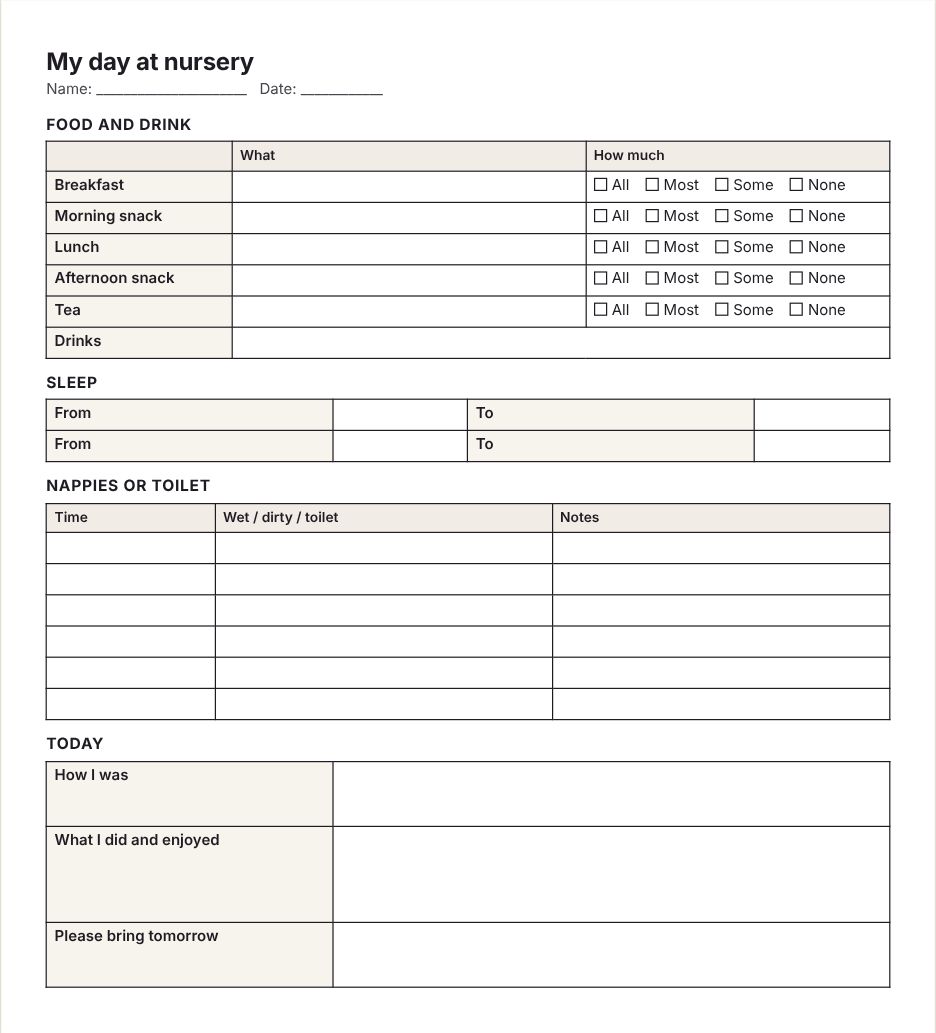
From working with families, the daily questions are nearly always the same. This is a judgement, not a regulation:
- Did they eat, and roughly how much?
- Did they sleep, and for how long?
- Nappies or toileting, and anything unusual.
- How were they in themselves?
- One thing they did or enjoyed, with a name or a detail.
- Anything the parent needs to do: bring spare clothes, sign a form, collect a bottle.
Parents rarely want the planning rationale every day. They want to know their child was known and noticed.
A communication rhythm staff can keep up
| What | Channel | Who | How often |
|---|---|---|---|
| Accident, injury or first aid | Written record, parent signs or acknowledges; a phone call first if it is a head bump or needs a decision | Staff member who saw it, checked by room leader | Same day |
| Medicine given | Medicine record, shown to the parent at collection | Staff member who gave it | Same day |
| Child unwell and needs collecting | Phone call | Room leader or manager | As it happens |
| Daily care summary (food, sleep, nappies, mood) | App or paper daily sheet | Key person, or whoever was with the child | Once, at the end of the day |
| A moment from the day | App post or a sentence at handover | Any staff member | A few a week per child, not every hour |
| Handover conversation | In person at collection | Key person where rotas allow | Daily, two minutes |
| Room news, menus, dates | Newsletter or notice board | Room leader or manager | Weekly or fortnightly |
| Learning and next steps | Meeting or short written note | Key person | Termly, plus the two-year check |
| Progress concern | Face-to-face meeting | Key person with SENCO or manager | When it arises |
| Policy or fee change | Letter or email | Manager | When it happens, with notice |
Three daily updates: good and less good
Food and sleep
- Less good: “Good day! Ate well, slept well.”
- Better: “Had all her pasta and asked for more peas. Slept 12.40 to 2.05. Two wet nappies, one dirty at 3pm.”
Mood
- Less good: “Bit clingy today.”
- Better: “Quiet after drop-off and wanted a cuddle with Priya for ten minutes. Settled once we got the water tray out and was chatting by snack.”
Something the parent needs to act on
- Less good: “Needs spare clothes.” (sent at 4.50pm, buried under three photos)
- Better: “We used his last spare set after water play. Could you pop two sets in his bag tomorrow? Wet clothes are in a bag on his peg.”
The better versions are specific, factual, and short enough to read at the gate.
Hard conversations belong in person
Never deliver bad news, a concern about development, or a complaint response by message. Text strips out tone, and a parent reads it alone at 10pm with no one to ask.
The framework expects you to have a space where staff can talk to parents confidentially (3.89; 3.88). Use it. A structure that works:
- Book it. “Could we have ten minutes on Thursday? It is nothing urgent, I just want to talk about how his talking is coming on.” Say whether it is urgent, or the parent will worry for three days.
- Start with the child. One genuine, specific thing you enjoy about them.
- Say what you have noticed, not what you think it means. “He is using about ten words. Most children in the room are putting two words together.”
- Ask what they see at home. You may learn the thing that changes the picture.
- Agree one next step and a date to talk again, then write a short note of what was agreed.
If a concern is about safeguarding, follow your safeguarding procedure and speak to your designated safeguarding lead before raising it with the family.
Childminders
The same requirements apply under the childminder framework. You are usually the key person, the manager and the person at the door, so the rhythm matters even more. Set your contact hours in your parent agreement and keep a work phone number separate from your personal one.
Questions we get asked
Do we have to reply to parents' messages in the evening?
No. The EYFS requires a regular two-way flow of information, not an instant one. Publish your response times and your emergency number, and make sure staff never use personal numbers for work contact.
Can a room leader run a WhatsApp group for their room's parents?
It is hard to do safely. It usually runs on a personal phone, puts parents' numbers in front of each other and keeps children's information outside your control. Government online safety guidance for early years says professional contact should go through setting-approved channels.
Does Ofsted expect a photo of every activity?
No. Ofsted states that it does not require photographic evidence of what children are doing and learning, and the EYFS says there is no requirement to keep written records of ongoing assessment.
Which things must parents hear about the same day?
Any accident or injury and any first aid given, any medicine given, and any occasion when physical intervention was used. The rule is the same day, or as soon as reasonably practicable.
Sources
- EYFS statutory framework for group and school-based providers, effective 1 September 2026 (DfE)
- EYFS statutory framework for childminders, effective 1 September 2026 (DfE)
- Safeguarding children and protecting professionals in early years settings: online safety guidance for practitioners (UKCIS / GOV.UK)
- Right of access: how do we find and retrieve the relevant information? (ICO)
- Early years inspection toolkit, for use from 1 September 2026 (Ofsted)
- Early years inspection information, for use from September 2026 (Ofsted)
- Help for early years providers: working in partnership with parents and carers (DfE)
This guide is for early years settings in England and reflects the sources above as of 25 September 2026. It is practical guidance, not legal advice: where it and the statutory framework differ, the framework wins. Spotted something out of date? Tell us at hello@coatpeg.co.uk.