
Giving medicine in a nursery: consent, records and the rules
You can only give a child medicine if a parent or carer has given written permission for that particular medicine. This applies to prescription and non-prescription medicines alike. You must write down every dose and tell the parent the same day, or as soon as reasonably practicable. Prescription medicines must have been prescribed by a doctor, dentist, nurse or pharmacist; medicines containing aspirin only by a doctor.
These rules are in paragraphs 3.61–3.62 of the EYFS framework for group and school-based providers and 3.60–3.61 of the childminder framework, both effective from 1 September 2026. The wording is identical and has not changed from the 2025 version apart from paragraph numbers. This guide is for settings in England.
What does the EYFS require for giving medicine?
Six things:
- A medicines policy and procedure that you actually follow, including how you find out about a child’s needs for medicine and keep that information up to date.
- Training for staff where giving the medicine needs medical or technical knowledge.
- Prescription medicines only when prescribed for a child by a doctor, dentist, nurse or pharmacist. Aspirin only if a doctor prescribed it.
- Written permission from the parent or carer for that particular medicine, before any dose.
- A written record every time a medicine is given.
- Telling the parent the same day the medicine was taken, or as soon as reasonably practicable.
Separately, all medication on the premises, including staff members’ own, must be stored securely and out of reach of children at all times (paragraph 3.28 for group settings, 3.29 for childminders).
Prescribed and non-prescribed: what is the difference?
Prescription medicines, such as antibiotics or a salbutamol inhaler, need a prescription from one of the four professions above. The pharmacy label tells you whose it is, the dose and how often.
Non-prescription medicines are anything bought over the counter: from a pharmacy, a supermarket or a health shop. Children’s paracetamol, ibuprofen, antihistamine and teething gel are the everyday ones. They need written parental permission, but no GP authorisation. The framework used to say medicines should be prescribed by a doctor, and the BMA has since confirmed that nurseries and schools do not need a GP’s signature for over-the-counter medicines. Asking parents to get one wastes an appointment.
Non-prescription does not mean low-risk. There is no pharmacy label with the child’s name and dose on it, so your consent form has to do that job.
Medication record: the fields to capture
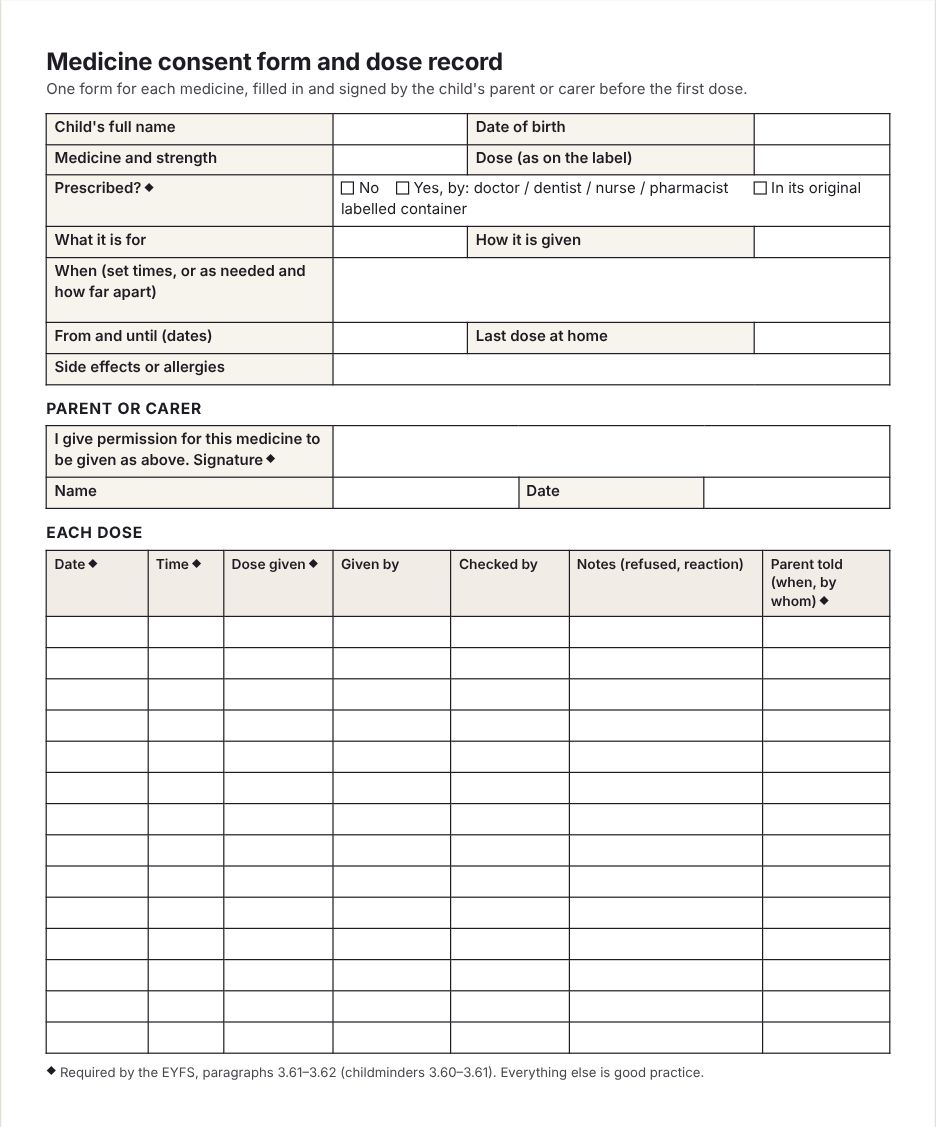
The EYFS does not prescribe a form. This field list covers what you need to prove the dose was right, and what a parent or inspector will look for.
From the parent, before the first dose (the consent):
- Child’s full name and date of birth
- Name of the medicine and its strength (for example 120mg/5ml)
- Prescribed or non-prescribed; if prescribed, who prescribed it
- Why it is needed
- Dose, how it is given, and at what times or in what circumstances
- Start date and end date or review date
- When the last dose was given at home
- Known side effects or allergies
- Parent’s name, signature or written message, and date
Each time a dose is given:
- Date and exact time
- Dose given (as a measured amount, not “one spoon”)
- Who gave it, and who checked it if you use a second person
- Label and expiry checked (yes or no)
- Anything notable: refused, spat out, vomited, reaction
- When and how the parent was told, and by whom
- Parent’s acknowledgement
A second member of staff checking the medicine, dose and child before each dose is not an EYFS requirement. In our view it is the cheapest protection there is against the wrong child getting the wrong medicine.
Before you give any dose: a checklist
Run this every time. It takes thirty seconds.
- Is there written permission for this medicine, for this child, still in date?
- If it is prescribed, does the pharmacy label show this child’s name?
- Is it in its original container, with the dosage instructions?
- Is it in date, and has it been stored as the label says (fridge or room temperature)?
- When was the last dose, at home or here? Is enough time left before this one?
- Is the dose you have measured the one on the consent and the label?
- Have you used a proper oral syringe or measuring spoon?
- Is the child the one you think it is? Check by name, not by room or cot.
- If the medicine needs training (for example an auto-injector), are you trained?
- After giving it: record it now, not at the end of the day.
- Plan when and how you will tell the parent today.
The original container and in-date checks come from DfE’s statutory guidance for schools. It does not bind private nurseries or childminders, but it is the clearest official benchmark available, and it is a good one.
Common mistakes
Giving paracetamol to bring a temperature down. The NHS advises giving paracetamol or ibuprofen to a child with a fever if they are distressed or uncomfortable, not simply to lower the number. It also advises not to alternate paracetamol and ibuprofen unless a health professional says so, not to give paracetamol under 2 months, and not to give ibuprofen under 3 months. A child under 3 months with a temperature of 38°C or more needs medical advice. Your policy on fever should say when you call the parent, not only when you reach for the bottle.
A dose at home that masks a fever. A child dosed with paracetamol before drop-off can seem fine until it wears off. Ask at handover whether any medicine was given that morning and write it down. That also stops a second dose being given too soon.
Vague blanket consent. The EYFS requires permission for that particular medicine. A registration form that says “we may give medicine if needed” does not meet it. If you ask parents for advance consent to emergency paracetamol, name the medicine and the circumstances, and phone the parent before each dose. Phoning first is practice, not a rule, but it catches the dose they gave at 7am.
Inhalers and auto-injectors left behind on outings. Emergency medicines must go wherever the child goes. The schools guidance says inhalers and adrenaline pens should not be locked away, particularly on trips. Stored securely and out of children’s reach does not mean locked in an office when the child is in the park. Put them in the outings bag and check them out and back in.
Expired or unlabelled medicine. Decanted into a pot, or a sibling’s inhaler brought in because the child’s ran out. Say no, kindly, and explain why.
The record written at the end of the day. By then nobody remembers whether it was 11:40 or 12:10. Write it at the time.
Training and specialist medication
Staff must have training if giving a medicine needs medical or technical knowledge. That will include adrenaline auto-injectors, emergency seizure medication, insulin and anything given by tube. The framework does not say who delivers it. Our view: get it from a health professional involved in the child’s care where you can, make it specific to the child, and record it with a refresh date. Paediatric first aid training alone is not a substitute.
For children with a known allergy, the EYFS asks you to work with parents and health professionals on an allergy action plan, and to refer to the British Society for Allergy and Clinical Immunology (BSACI) plan. See safer eating and allergies.
Storage
- Store all medicines securely and out of children’s reach, including staff medication in bags.
- Follow the label for temperature. A dedicated, lockable medicines fridge is better than the milk fridge.
- Keep each child’s medicines together, labelled with their name and photo if helpful.
- Emergency medicines stay with the child’s group and go on outings.
- Return unused and out-of-date medicines to parents for disposal, and record it.
Telling parents the same day
The duty is to tell the parent on the day the medicine was taken, or as soon as reasonably practicable. Tell them what was given, how much, and when, so they do not give the next dose too early. A written copy at collection is best; a verbal mention at a busy door is the version that gets forgotten.
If a child needs medicine regularly, review the consent with the family whenever the dose changes and at least every term. The EYFS requires your information about a child’s medicine needs to be kept up to date, and the key person is usually best placed to ask.
Questions we get asked
Do we need a doctor's letter to give Calpol?
No. The EYFS only requires a prescription for prescription medicines. Non-prescription medicines such as children's paracetamol need the parent's written permission for that medicine, and the BMA confirms a GP signature is not needed.
Can a parent give consent by text or phone?
The EYFS requires written permission and does not define the format. A phone call alone is not written. If you decide to accept a text or email, say so in your policy and keep the message with the record.
Can we give a child their sibling's inhaler?
No. A prescription medicine must have been prescribed for a child by an authorised prescriber, and your consent must be for that medicine. Give a child only medicine labelled for them.
Do staff need training to give medicine?
The EYFS requires training where giving the medicine needs medical or technical knowledge. Adrenaline auto-injectors, emergency seizure medicine and insulin are typical examples; get training from a health professional and record it.
Is the rule different for childminders?
No. The childminder framework has the same requirements at paragraphs 3.60–3.61, and applies them to childminders and their assistants.
Sources
- Early years foundation stage statutory framework for group and school-based providers, effective 1 September 2026 (DfE)
- Early years foundation stage statutory framework for childminders, effective 1 September 2026 (DfE)
- Prescribing over-the-counter medicines in nurseries and schools (BMA)
- High temperature (fever) in children (NHS)
- Supporting pupils at school with medical conditions: statutory guidance for schools (DfE)
This guide is for early years settings in England and reflects the sources above as of 24 September 2026. It is practical guidance, not legal advice: where it and the statutory framework differ, the framework wins. Spotted something out of date? Tell us at hello@coatpeg.co.uk.